Biceps Tendinitis
What Is Biceps Tendinitis?
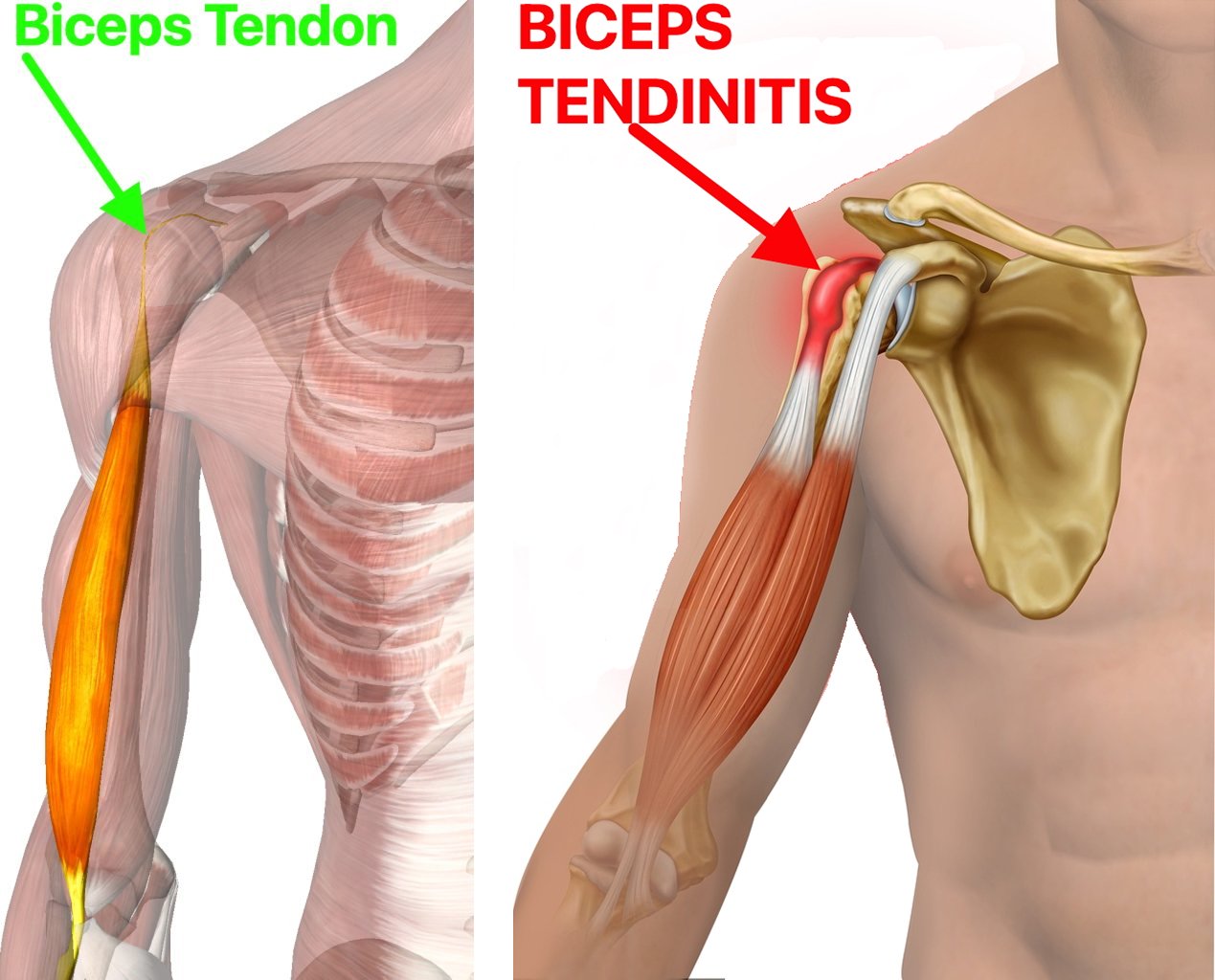
Biceps tendinitis, like other forms of tendinitis, is marked by inflammation of the tendon tissue. This inflammation can lead to a thickening and swelling of the tendon sheath (the outer membrane containing the cord-like tendon fibers). Tenderness and soreness may result.
These changes in the biceps tendon’s shape may also affect the mechanics of the shoulder joint, leading to a popping or snapping when you lift your arm above your head or otherwise use the joint.
Other symptoms of biceps tendinitis include:
- Soreness or aches that radiate down the length of the upper arm
- Increased pain with overhand motions (like serving a tennis ball or painting a wall) or when lifting items overhead (e.g., airplane carry-on bags).
Causes of Biceps Tendinitis
- Normal wear and tear. Most of the time, biceps tendonitis is an age-related wear-and-tear condition. As we get older, the collagen in our tendons begins to break down and become less elastic—more subject to irritation, fraying, and ruptures.
- Repetitive motions using the shoulder and arm can hasten or worsen damage that might have happened anyway. Athletes may be vulnerable to biceps tendonitis due to overuse and over-straining the tendons when moving the arm with force or when lifting heavy weights. Overhand motions are often to blame: for example, serving a tennis ball, playing handball, swinging from bars or ropes (Crossfit!), throwing a baseball, or swimming the crawl.
Risk Factors for Biceps Tendonitis
Though anyone can develop biceps tendinitis, you are in a higher risk category if you meet the following criteria:
- Age (30+). All forms of tendinitis are more likely as we get older, due to normal age-related wear and tear.
- Other shoulder damage. Osteoarthritis of the shoulder, shoulder impingement, SLAP lesion tears, rotator cuff injuries, frequent dislocations or instability, inflammation of the lining of the shoulder socket—these sometimes accompany tendonitis or make its occurrence more likely.
- Athletics or occupation. Frequent, repetitive use of the shoulder, especially overhand motions or lifting heavy items overhead, can increase your risk.
- Smoking has been associated with an increased risk of tendon damage and rupture, along with slower healing due to poor circulation.
- Being significantly overweight may make you more likely to experience collagen breakdown.
Why See a Doctor for biceps tendonitis?
Getting a diagnosis of tendonitis is important. A nagging pain and weakness may feel like something you can ignore and “push through,” but know that biceps tendonitis, if it progresses to frays and a more significant breakdown of tissue, can lead to a partial or full rupture of the biceps tendon. This injury can lead to significant weakness and disability in the arm.
Full tendon tears cannot repair themselves; surgery would be needed to repair the torn tissue and reattach the biceps muscle to bone.
By seeing an orthopedist early, you can get a diagnosis and talk to your doctor about options for non-surgical, conservative treatment (usually a combination of rest and anti-inflammatory medications).
If you’re an athlete or depend on shoulder and arm strength for your occupation, surgery to diagnose and repair damaged tendon tissue may also be an option.
Treatment
Nonsurgical Treatment
Effective for most patients.
Rest and Activity Modification / Avoidance
Ice. Apply cold packs for 20-30 minutes at a time, several times a day, to keep swelling down. Not directly on skin.
Nonsteroidal anti-inflammatory drugs (NSAIDs). Anti-inflammatory drugs like ibuprofen, aspirin, and naproxen can reduce pain and swelling.
Steroid injections. Injecting steroids (cortisone) around the tendon can relieve pain. Not everyone is a suitable candidate. Given the location of the tendon within its sheath, these injections are often done under image guidance, such as with an ultrasound.
Physical therapy. Specific stretching and strengthening exercises can improve symptoms and function.
Surgical Treatment
If nonsurgical treatment is not effective, surgery may an option.
Surgery for biceps tendinitis is usually performed arthroscopically (key hole surgery) .
Biceps tenodesis. In some cases, the damaged section of the biceps is removed, and the surgeon reattaches the remaining tendon to the humerus (upper arm bone). This procedure is called a biceps tenodesis. Removing the painful part of the biceps usually resolves symptoms and restores normal function.
Tenotomy. In some cases, the long head of the biceps tendon may be so damaged that it is not possible to tenodese it. An option is to release the damaged biceps tendon from its attachment to bone. This is called a biceps tenotomy.
This option is the least invasive but may result in a Popeye bulge in the arm.
Patients who have tenotomy usually do well and return to near normal strength. This surgery also has the shortest recovery time.
Surgical complications. Complication rates are low.
Possible complications include:
- Infection
- Stiffness
- If a tenodesis was performed, possible rupture of the tendon and/or pain where the tendon was reattached
- If a tenotomy was performed, possible cramping in the muscle (self-limiting)
Rehabilitation. After surgery, your doctor will prescribe a rehabilitation plan based on the procedures performed. You may wear a sling for a few weeks.
Your doctor may restrict certain activities to allow the repaired tendon to heal. It is important to follow your doctor’s directions after surgery to avoid damage to your repaired biceps.
Your doctor will start you on therapeutic exercises a few weeks after surgery. They may refer you for physical therapy, but PT is not always necessary.
- Flexibility exercises will improve range of motion in your shoulder.
- Exercises to strengthen your shoulder will gradually be added to your rehabilitation plan.
Surgical outcome. Most patients have good results. They typically regain full range of motion and are able to move their arms without pain.
People who play very high-demand overhead sports occasionally need to limit these activities after surgery.
