Expert Treatment for Elbow Instability and Ligament Injuries
Collateral Ligament Injury of the Elbow
A feeling of instability, clicking, or giving way in your elbow can be alarming, especially for athletes and active individuals. These symptoms often point to an injury of the crucial ligaments that stabilize the joint. An injury to the Medial Collateral Ligament (MCL)(opens in a new tab) on the inner side of the elbow, or the Lateral Collateral Ligament (LCL) on the outer side, can result from a traumatic dislocation or from the repetitive stress of overhead throwing motions. This damage can cause significant pain and prevent you from performing at your best. Seeking care from a top orthopedic surgeon is essential for an accurate diagnosis and effective elbow injury treatment.
Dr. Srinath Kamineni is a premier orthopedic surgeon in Mount Carmel, IL, specializing in complex elbow ligament reconstruction, including the famous Tommy John surgery. As a double fellowship-trained and board-certified surgeon in both the USA and England, Dr. Kamineni provides an elite level of care for patients with elbow instability. He has extensive experience helping athletes and non-athletes alike return to their activities with a strong, stable elbow. If you are looking for an elbow specialist near you to address a potential ligament injury, a consultation is your first step toward recovery.
Our team makes it simple to schedule an appointment. Contact us today to arrange a consultation with Dr. Kamineni and get on the path to a stable and pain-free elbow.
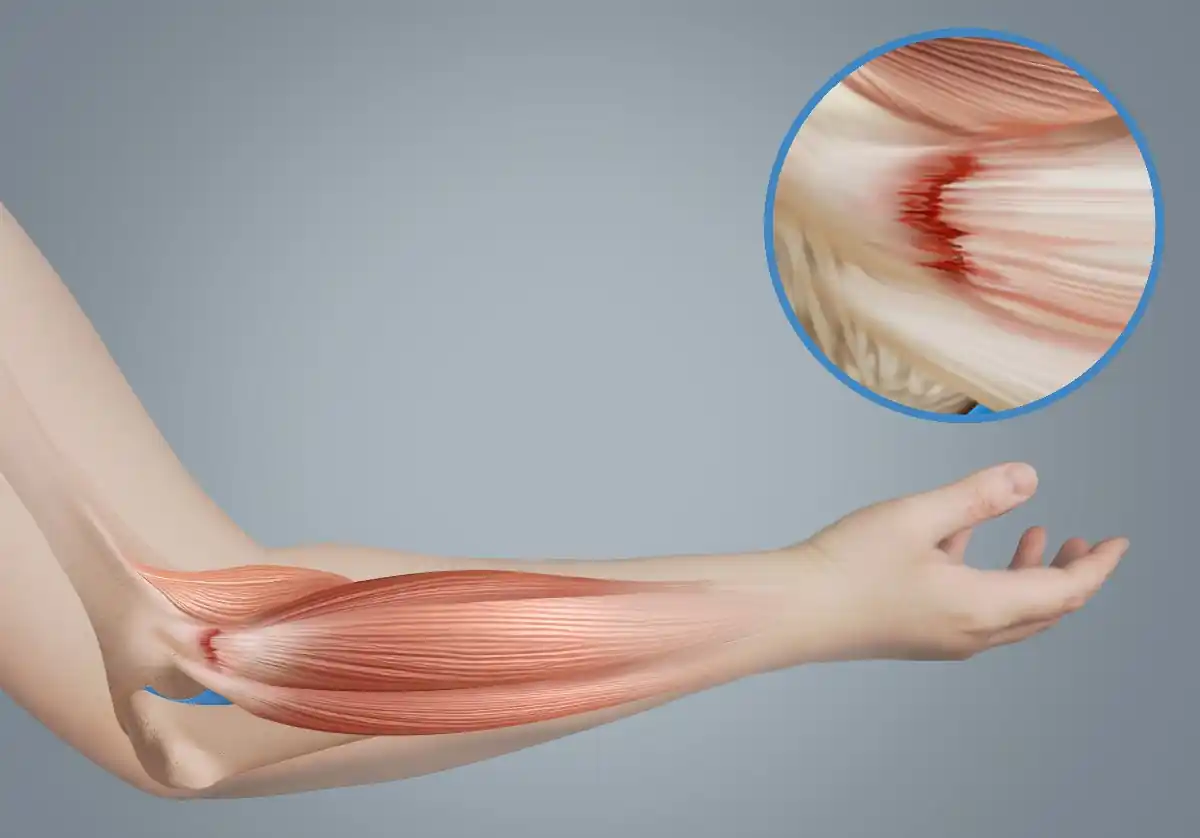
Understanding Elbow Collateral Ligament Injuries
The elbow relies on two primary collateral ligaments for side-to-side stability. The Medial Collateral Ligament (MCL) — also called the Ulnar Collateral Ligament (UCL) — runs along the inner side of the elbow and is the primary stabilizer against the valgus stress created during overhead throwing. The Lateral Collateral Ligament (LCL) runs along the outer side and resists varus stress and rotational forces. When either ligament is damaged, the result is pain, weakness, and a loss of confident, controlled elbow movement.
UCL/MCL Tear (Schematic)
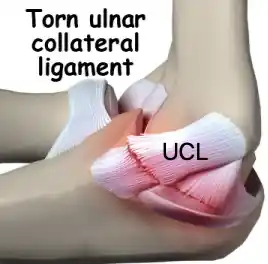
UCL/MCL Tear (MRI)
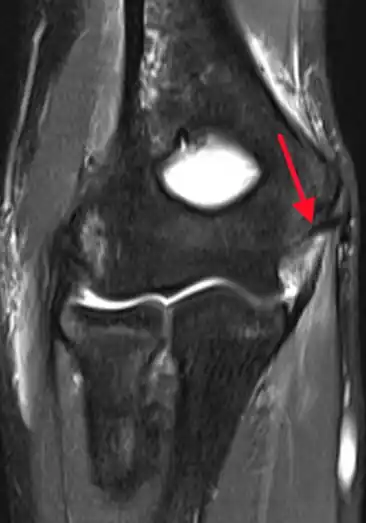
Healthy Elbow (Normal)

Frequently Asked Questions
What Are Elbow Ligament Injuries?
The elbow is stabilized by a network of strong ligaments. A medial collateral ligament elbow injury(opens in a new tab) affects the ligament on the inner side of the elbow and is common in throwing athletes due to the high stress placed on this area. This is the injury famously repaired by Tommy John surgery. An LCL elbow injury involves the ligaments on the outer side of the elbow and is more often caused by trauma, such as a dislocation, which can lead to a feeling of the elbow "popping out" or giving way — a condition known as posterolateral rotatory instability. Both types of injuries compromise the stability of the joint and require specialized care to restore proper function.
What is Tommy John Surgery?
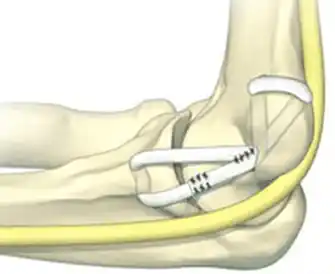
Tommy John surgery is a specific type of elbow ligament reconstruction designed to repair a torn medial collateral ligament (MCL). The procedure is named after the first baseball pitcher to successfully undergo the operation. A torn MCL cannot be simply stitched back together, so the procedure involves replacing the damaged ligament with a tendon taken from another part of the patient's body (an autograft) or from a donor (an allograft). This new tendon is woven through tunnels drilled in the bones of the upper arm (humerus) and forearm (ulna) to create a new, stable ligament structure. Learn more about Tommy John surgery at Mayo Clinic(opens in a new tab). This surgery has saved the careers of countless overhead athletes.
Tommy John Surgery — MCL Reconstruction
How is an LCL Injury Treated?
The treatment for an LCL injury depends on its severity and the degree of instability. Minor sprains may be treated non-surgically with bracing and physical therapy to strengthen the surrounding muscles. However, for complete tears or chronic instability where the elbow feels loose or dislocates, surgery is often necessary. The surgical procedure involves an elbow ligament reconstruction where the torn LCL is repaired or, if the tissue quality is poor, reconstructed using a tendon graft. As an expert orthopaedic surgeon in Mount Carmel, IL, Dr. Kamineni has the skill to perform these intricate reconstructions to restore stability and prevent long-term joint damage.
What are LCL Elbow Injury Symptoms?
The primary LCL elbow injury symptoms include a feeling of instability, as if the elbow is slipping or popping out of place, especially when pushing up from a chair or extending the arm with the palm down. Patients may also experience pain, clicking, or locking on the outer side of the elbow. These symptoms can be subtle at first but often become more pronounced over time. A history of a previous elbow dislocation is a major risk factor. An accurate diagnosis by an elbow specialist is crucial, as these symptoms can sometimes be mistaken for other conditions like tennis elbow (lateral epicondylitis)(opens in a new tab).
Am I a Candidate for Elbow Ligament Reconstruction?
You may be a candidate for elbow ligament reconstruction if you have persistent elbow instability that interferes with your daily activities or sport. If you're an athlete, a torn MCL that prevents you from throwing at full velocity is a clear indication that Tommy John surgery is for you. For an LCL injury, if you experience recurrent instability despite non-surgical treatment, reconstruction is often recommended to protect the joint from further damage and arthritis(opens in a new tab). Dr. Kamineni will perform a comprehensive physical examination, review your imaging (such as an MRI(opens in a new tab)), and discuss your activity goals to determine if you are a suitable candidate for surgery.
How Do I Schedule an Appointment with an Orthopaedic Surgeon in Southern Illinois?
Finding an expert to manage your elbow instability is critical. We make it easy to schedule a consultation with Dr. Srinath Kamineni, a leading elbow specialist in southern Illinois. Our professional staff is here to help you find a convenient appointment time and answer any questions you may have. You can reach our office by phone or use our online scheduling portal to request your visit. Don't let elbow instability sideline you from your life. Contact us today to get the expert care you need for a successful recovery.
What is the recovery time for Tommy John surgery?
Recovery from Tommy John surgery is a lengthy process. It involves a highly structured rehabilitation program that can last from 12 to 18 months before an athlete can expect to return to competitive throwing. The focus is on protecting the graft while gradually restoring motion, strength, and finally, sport-specific mechanics. Learn more about UCL reconstruction recovery at AAOS(opens in a new tab).
Can I get an LCL injury without dislocating my elbow?
While LCL injuries are most commonly associated with elbow dislocations(opens in a new tab), it is possible to injure the ligament through other forms of trauma or repetitive strain, though this is less common. Any event that forces the elbow into an unnatural varus (bow-legged) position can potentially damage the LCL.
Will I be able to return to my sport after surgery?
The success rates for both Tommy John surgery and LCL reconstruction are very high, especially when performed by an experienced surgeon. The vast majority of athletes are able to return to their previous level of competition after completing their rehabilitation program. Dr. Kamineni's expertise is focused on helping patients achieve this goal.