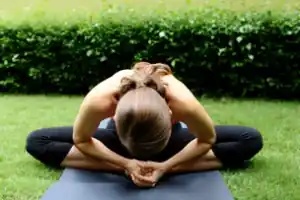
Sitting Poses
From: Stretch! An Illustrated Step-By-Step Guide To 90 Slimming Yoga Postures by Nika Florek
Sitting yoga poses form the foundation of many meditative and stretching practices. They range from simple cross-legged positions to deeper forward bends and twists, each offering unique benefits for the spine, hips, and digestive system. This guide provides step-by-step instructions, precautions, and benefits for each posture.
1. Easy Meditation Pose
Instructions
- Sit with legs straight in front of the body.
- Bend both legs and cross them in front of your body.
- Place the hands on the knees.
- Close your eyes.
- Keep the head, neck and back upright and straight.
- Relax the whole body.
- Arms should be relaxed and not held straight.
Precautions
People with severe knee problems should not sit in this posture for too long.
Benefits
- This is the easiest and most comfortable meditative pose.
- It facilitates mental and physical balance without strain or pain.

2. Half Lotus Pose
Instructions
- Sit with legs straight in front of the body.
- Bend one leg and place the sole of the foot on the inside of the opposite thigh.
- Bend the other leg and place the foot on top of the opposite thigh.
- Without any strain, try to place the upper heel as near as possible to the abdomen.
- Adjust the position so that it is comfortable.
- Place the hands on the knees and close your eyes.
- Keep the head, neck and back upright and straight.
- Relax the whole body. Arms should be relaxed and not held straight.
Precautions
People suffering from sciatica or weak or injured knees should not perform this posture.
Benefits
- Allows the body to be held completely steady for long periods, holding the trunk and head like a pillar with the legs as a firm foundation.
- Applies pressure to the lower spine, which has a relaxing effect on the nervous system.
- The breath becomes slow, muscular tension is decreased and blood pressure is reduced.
- The normally large blood flow of the legs is redirected to the abdominal region, stimulating the digestive process.
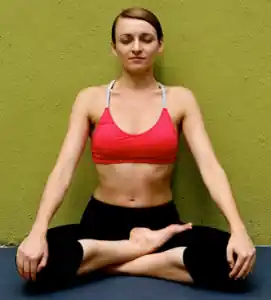
3. Lotus Pose
Instructions
- Sit with legs straight in front of the body.
- Bend the left knee and place the left foot on the right thigh.
- Bend the right knee and place the right foot on the left thigh.
- Adjust the pose so that it is comfortable; the knees should be firmly on the floor.
- Place the hands on the knees and close your eyes.
- Keep the head, neck and back upright and straight.
- Relax the whole body. Arms should be relaxed and not held straight.
Precautions
People with sciatica or sacral infections should not perform this posture.
Benefits
- A healthy position to sit in, especially for those suffering from varicose veins, tired and aching muscles or fluid retention in the legs.
- Increases the efficiency of the entire digestive system, relieving stomach ailments such as hyperacidity and peptic ulcer.
- You can practise Vajrasana directly after meals for at least 5 minutes to enhance digestive function.

4. Thunderbolt Pose I
Instructions
- Kneel on the floor with the knees close together.
- Bring the big toes together and separate the heels.
- Lower the buttocks onto the inside surface of the feet with the heels touching the sides of the hips.
- Place the hands on the thighs, palms down.
- The back and head should be straight but not tense.
- Close the eyes, relax the arms and the whole body.
Option: If there is pain in the thighs or ankles, the knees may be separated slightly. You can also place a pillow below your buttocks.
Precautions
Be careful with your ankles and knees.
Benefits
- Alters the flow of blood and nervous impulses into the pelvic region and strengthens the pelvic muscles.
- Increases the efficiency of the entire digestive system, relieving stomach ailments such as hyperacidity and peptic ulcer.
- This is the only posture you can practise directly after meals, for at least 5 minutes, to enhance digestive function.

5. Thunderbolt Pose II
Instructions
- From Thunderbolt Pose I, bring your hands to the back and interlock the fingers.
- Inhale, raise your head up and expand the chest.
- Exhale, bend forward and rest the chest on the thighs and forehead on the floor.
- Raise the hands up so that the shoulder blades come close to each other.
- Hold the pose for 5 breaths.
- Inhale, drop the hands on your lower back and slowly raise the head and upper body up.
- Exhale, go back to the starting pose — place the hands on the thighs, palms down and look forward.
Option: If you have tight shoulders, you can just rest your hands on the lower back without raising them.
Precautions
Be careful with your ankles, knees and shoulders.
Benefits
- Increases the efficiency of the entire digestive system, relieving stomach ailments such as hyperacidity and peptic ulcer.
- Stretches and strengthens the shoulders and arms.
6. Thunderbolt Pose III
Instructions
- From Thunderbolt Pose I, bring your left palm below the belly button and place the right palm on top.
- Inhale, raise your head up and expand the chest.
- Exhale, bend forward and rest the chest on the thighs and forehead on the floor. Your palms press the stomach.
- Hold the pose for 5 breaths.
- Inhale, slowly raise the head and upper body up.
- Exhale, go back to the starting pose.
Precautions
Be careful with your ankles and knees. Should not be performed by people with gastric problems.
Benefits
- Speeds up digestion due to the pressure on the stomach.
- Helps remove excess wind or gas.
- Adds strength to the calf and thigh muscles.
7. One Leg Forward Bend I
Instructions
- Sit on the floor with your legs outstretched and spread apart as far as possible.
- Inhale, raise both hands up above the head.
- Exhale, twist the trunk and bend forward to the left leg. Grab hold of your left toe (or calf).
- Bring the forehead to the knee; keep the knee straight.
- Hold the pose for 5 breaths.
- Inhale, raise both hands above the head. Exhale, twist to the right side and repeat.
Precautions
People suffering from slipped disc, sciatica or hernia should not practise this posture.
Benefits
- Stretches hamstring muscles and increases flexibility in the hip joints.
- Tones and massages the entire abdominal and pelvic region.
- Removes excess weight in the abdominal area and stimulates circulation to the nerves and muscles of the spine.
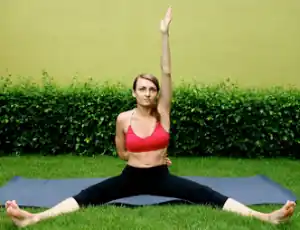
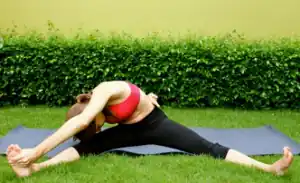
8. One Leg Forward Bend II
Instructions
- Sit on the floor with your legs outstretched and spread apart as far as possible.
- Bring your left hand up and rest your right hand on the back.
- Twist your trunk and bend forward to your right leg; grab hold of your right toe (or calf) with your left hand.
- Inhale, raise your head up and look up.
- Exhale, bend forward and bring the forehead as close as possible to the knee. Keep both knees straight.
- Hold the pose for 5 breaths.
- Inhale, raise your head and left hand up; bring your left hand to the back and right hand up, twist to the left side and repeat.
Precautions
People who suffer from slipped disc, sciatica or hernia should not practise this posture.
Benefits
- Stretches hamstring muscles and increases flexibility in the hip joints.
- Tones and massages the entire abdominal and pelvic region.
- Removes excess weight in abdominal area and stimulates circulation to the nerves and muscles of the spine.
9. Two Legs Forward Bend I
Instructions
- Sit on the floor with your legs outstretched and spread apart as far as possible.
- Inhale, raise both hands up above the head.
- Exhale, bend forward and grab hold of your left toe with your left hand and right toe with your right hand.
- Try to bring your forehead to the floor in between the knees; keep both knees straight.
- Hold the pose for 5 breaths.
- Inhale, raise both hands and head up. Exhale, release both hands on the floor next to the thighs.
Precautions
People suffering from slipped disc, sciatica or hernia should not practise this posture.
Benefits
- Stretches hamstring muscles and increases flexibility in the hip joints and spine.
- Tones and massages the entire abdominal and pelvic region.
- Removes excess weight in abdominal area and stimulates circulation to the nerves and muscles of the spine.
10. Two Legs Forward Bend II
Instructions
- Sit on the floor with your legs outstretched, feet together.
- Inhale, raise both hands up above the head.
- Exhale, bend forward, slide the hands down the legs and grab hold of your feet (alternative: ankles or calves).
- Bring your head as close as possible to the knees, keeping your knees straight.
- Hold the pose for 5 breaths.
- Inhale, raise both hands up. Exhale, release both hands on the floor next to the thighs.
Precautions
People suffering from slipped disc, sciatica or hernia should not practise this asana.
Benefits
- Stretches hamstring muscles and increases flexibility in the hip joints and spine.
- Tones and massages the entire abdominal and pelvic region.
- Removes excess weight in abdominal area and stimulates circulation to the nerves and muscles of the spine.
11. Twisted Pose I
Instructions
- Sit on the floor with your legs outstretched, feet together.
- Bend the left knee and place the foot on the floor.
- Inhale, raise both hands up above the head.
- Exhale, turn the trunk to the right side and place the right palm behind the right buttock and the left palm next to the right thigh, fingers pointing toward each other.
- Twist the head and trunk as far to the right as is comfortable, using the arms as levers, keeping the spine upright and straight.
- Look over the right shoulder as far as possible without straining.
- Hold the final position for 5 breaths.
- Inhale, straighten your head and raise both hands above the head, re-centre the trunk. Exhale, release the hands and repeat on the other side.
Precautions
People with back complaints should be careful with this posture.
Benefits
- Stretches the spine, loosens the vertebrae and tones the nerves.
- Alleviates backache, neck pain, lumbago and mild forms of sciatica.
12. Twisted Pose II
Instructions
- Sit on the floor with your legs outstretched, feet together.
- Bend the right knee and place the foot on the floor.
- Inhale, raise both hands up above the head.
- Exhale, turn the trunk to the right side and place the right palm behind the right buttock, and the left palm on the right shoulder; left elbow is pressing on the right knee.
- Twist the head and trunk as far to the right as is comfortable, keeping the spine upright.
- Look over the right shoulder as far as possible without straining.
- Hold the final position for 5 breaths.
- Inhale, straighten your head and raise both hands above the head, re-centre the trunk. Exhale, release the hands and repeat on the other side.
Precautions
People with back complaints should be careful with this posture.
Benefits
- Stretches the spine, loosens the vertebrae and tones the nerves.
- Alleviates backache, neck pain, lumbago and mild forms of sciatica.

13. Sitting Half Boat Pose
Instructions
- Sit on the floor with your legs outstretched, feet together.
- Inhale, bend the left knee, grab hold of your left foot (alternative: ankle, heel, calf) and stretch the leg up.
- Keep the back and knee straight and try to bring your leg as close as possible to the forehead.
- Gaze at the big toe and hold the pose for 5 breaths.
- Exhale, slowly release the leg on the floor. Repeat on the other side.
Precautions
People with back complaints or a displaced coccyx should not practise this pose.
Benefits
- Stretches the hamstring muscles and improves flexibility of hip joints.
- Tones abdominal muscles.
- Strengthens arms and spine muscles.
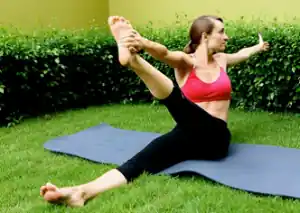
14. Twisted Forward Stretch
Instructions
- From the Sitting Half Boat Pose, inhale and grab hold of the outer side of your left foot (option: ankle, heel, calf) with your right hand.
- Twist the trunk towards the left side; extend the left arm to the back at shoulder level.
- Turn the head to the back and gaze over the left shoulder at your left palm.
- Keep your knees and back straight.
- Hold the pose for 5 breaths.
- Exhale, straighten your head and trunk, release your left hand and bring the left leg down. Repeat on the other side.
Precautions
People with back complaints or a displaced coccyx should not practise this asana.
Benefits
- Stretches the hamstring muscles and improves flexibility of hip joints.
- Tones abdominal muscles.
- Strengthens arms and spine muscles.
- Gentle twist of the lower back strengthens lower back muscles.
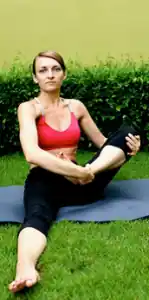
15. Hip Rocking Pose
Instructions
- Sit on the floor with the legs outstretched, feet together.
- Inhale, bend the left knee, grab hold of the left knee and ankle and bring the hip to the side.
- Straighten your back and start rocking the hip left and right (the movement is like rocking a baby).
- Rock the leg for 5 breaths.
- Slowly release the leg on the floor. Repeat on the other side.
Precautions
People with back complaints or a displaced coccyx should not practise this pose.
Benefits
- Opens and releases tension in the hip.
- Improves flexibility of the hip joints.
- Tones abdominal muscles.
- Strengthens the spine.
16. Butterfly Pose
Instructions
- Sit on the floor with the legs outstretched, feet together.
- Inhale, pull in your feet and place the soles of the feet together, as close as possible to your pelvis; let the knees fall out to the sides.
- Bounce the knees gently (like a butterfly flapping its wings).
- Breathe normally and keep bouncing the knees for the duration of 5 breaths.
- Release the legs and return to the starting position.
Precautions
People with sciatica or knee problems should not practise this pose.
Benefits
- Improves flexibility in the groin and hips region.
- Relieves inner thigh muscle tension.
- Removes tiredness from long hours of walking or standing.
- Prepares the legs for other meditative postures.
17. Cobbler's Pose
Instructions
- Sit on the floor with the legs outstretched, feet together.
- Inhale, pull in your feet and place the soles of the feet together, as close as possible to your pelvis; let the knees fall out to the sides. Keep the spinal chord and neck straight.
- Inhale, grasp your feet, raise your head up and bend back slightly.
- Exhale, bend forward, bringing your forehead all the way down to the big toes.
- Press the elbows against the thighs, bringing them closer to the floor.
- Hold the pose for 5 breaths.
- Inhale, raise the head and trunk up. Exhale, return to the starting pose.
Precautions
People with sciatica or knee problems should not practise this pose.
Benefits
- Improves flexibility in the groin and hips region.
- Relieves inner thigh muscle tension.
- Soothes the lower abdominal organs and helps the excretory system remove waste from the body.