Shoulder Anatomy
The shoulder girdle is a sophisticated mechanism that acts as the fulcrum (or pivot point) for the upper limb, and its smooth function, strength and stability are vital in order to reliably place the hand in space to undertake everyday tasks. It is comprised of many bones, joints, bursae, muscles, tendons, ligaments, and neurovasculature.
The shoulder is composed of 3 bones: the scapula (shoulder blade), the clavicle (collarbone), and the humerus (arm bone). These bones are linked by ligaments to form joints, upon which framework the tendons and muscles facilitate movement.

Front View

Back View
The Three Bones of the Shoulder
Scapula (Shoulder Blade)
The scapula is a large flat bone which has a body (the flat part), a spine (the ridge at the back of the shoulder), an acromion (tip of the shoulder blade) and a coracoid process (a projection from the front of the blade that serves as an attachment point for muscles and ligaments). It is integral to shoulder motion by moving around the posterior aspect of the thorax. In combination, the shoulder girdle allows for the most movement of all of the body's joints.


Clavicle (Collarbone)
The clavicle, through the medial sterno-clavicular joint and the lateral acromioclavicular joints, acts as a load transmitting bony structure between the upper limb and the axial skeleton.

Humerus (Arm Bone)
The humerus has the long shaft of the upper arm and ends with the humeral head, which articulates with the glenoid. There is a groove for the long head of the biceps muscle and tuberosities (bumps) for the attachment of the rotator cuff muscles.

Joints
These bones are linked by ligaments to form four key joints:
- Glenohumeral Joint (GHJ) — the main ball and socket joint of the shoulder girdle
- Scapulothoracic Joint (STJ) — a plane of motion between the shoulder blade and chest wall
- Acromioclavicular Joint (ACJ) — between the collarbone and the shoulder blade
- Sternoclavicular Joint (SCJ) — between the breastbone and the collarbone
- Humeral head coracoclavicular ligament articulation


Ligaments
These bones and joints depend on linkages provided by ligaments — tough, fibrous, flexible bands. Some of the important ligaments are:
- Coraco-clavicular ligaments (CCL) — suspending the scapula from the collarbone
- Acromio-clavicular ligaments — connecting the collarbone to the tip of the shoulder blade
- Coraco-acromial ligaments (CAL) — forms an arch over the ball of the humerus
- Glenohumeral ligaments (GHL) — three in number (superior, middle and inferior) connecting the ball and socket, preventing dislocation
- Transverse humeral ligament


Muscles
The shoulder is supported and moved by several groups of muscles. The following muscles begin at the base of the skull and connect the scapula and clavicle to the trunk of the body: Trapezius, Levator scapulae, Rhomboid Minor, and Rhomboid Major.
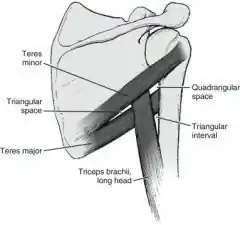
The following five muscles connect to the proximal end of the humerus and secure it to the body: Pectoralis major, Pectoralis minor, Teres major, Latissimus dorsi, and Deltoid.


Rotator Cuff
The four muscles of the rotator cuff connect the scapula to the humerus and provide support for the glenohumeral joint. They are:
- Subscapularis
- Supraspinatus
- Infraspinatus
- Teres Minor


Nerves, Arteries & Spaces
The shoulder is richly supplied with nerves and blood vessels. Nerves carry sensory signals from the joint tissues to the brain and convey motor signals from the brain via the spinal cord to the muscles.
Key Nerves
- Axillary — supplying the deltoid muscle
- Suprascapular — supplying the supraspinatus and infraspinatus
- Musculocutaneous — supplying the biceps and brachialis muscles
- Accessory — supplying the trapezius muscle