Understanding a Shoulder Dislocation
A shoulder dislocation is a painful and often dramatic injury where the ball of the upper arm bone (humerus) comes completely out of its socket in the shoulder blade. The shoulder joint, known for being the most mobile joint in the body, is unfortunately also the most prone to dislocation. In a stable shoulder, the ball-shaped head of the humerus fits snugly into the shallow socket (glenoid), held securely by a network of ligaments, the joint capsule, and a rim of cartilage called the labrum. A dislocation occurs when a significant force overwhelms these structures, pushing the ball out of its normal position.
When someone experiences a shoulder dislocation, it is not just a momentary slip; the joint is truly "out of place" and usually needs to be put back in by a medical professional. This event can cause significant damage to the surrounding soft tissues, which can lead to future problems, including a higher risk of the shoulder dislocating again.
This article will provide a detailed overview of shoulder dislocations, including how they happen, the immediate signs and symptoms, and the potential long-term consequences. We will explore how this single event can lead to chronic shoulder instability and what you should do if you suspect you have dislocated your shoulder.
The Anatomy of the Shoulder: Why It's Prone to Dislocation
To understand why shoulder dislocations happen, it helps to know a little about the shoulder's design. The main shoulder joint (the glenohumeral joint) is a ball-and-socket joint. However, unlike the deep socket of the hip joint, the shoulder's socket is very shallow and flat, more like a saucer than a cup. This design allows for an incredible range of motion—you can move your arm in almost any direction—but this mobility comes at the cost of stability.
The shoulder relies on several key structures to keep the ball centered in the socket:
- The Labrum: This is a rim of tough, flexible cartilage that deepens the shallow socket, acting like a bumper to help keep the humeral head in place.
- Ligaments and the Joint Capsule: A web of strong ligaments forms a sac-like structure called the joint capsule, which encases the joint and provides static stability.
- The Rotator Cuff: This group of four muscles and their tendons surrounds the joint, providing dynamic stability by actively holding the ball in the socket during movement.
A shoulder dislocation occurs when a force is strong enough to stretch or tear these stabilizing structures, allowing the humeral head to pop out of the socket.
How Does a Shoulder Dislocation Happen?
The vast majority of shoulder dislocations are caused by a traumatic injury. It takes a significant amount of force to push a healthy shoulder out of its socket. Common causes include:
- Falls: Falling onto an outstretched arm is a classic cause. The impact travels up the arm and can lever the humeral head out of the socket. This is common in sports like skiing and gymnastics, or simply from accidental falls.
- Direct Blows: A direct, hard impact to the shoulder, such as from a tackle in football or a check in hockey, can knock the joint out of place.
- Sudden, Forceful Arm Movements: A sudden, violent twist or pull on the arm can cause a dislocation. For example, trying to block a shot in basketball or getting your arm caught and pulled can generate enough force.
- Motor Vehicle Accidents: The high impact of a car crash can easily lead to a shoulder dislocation.
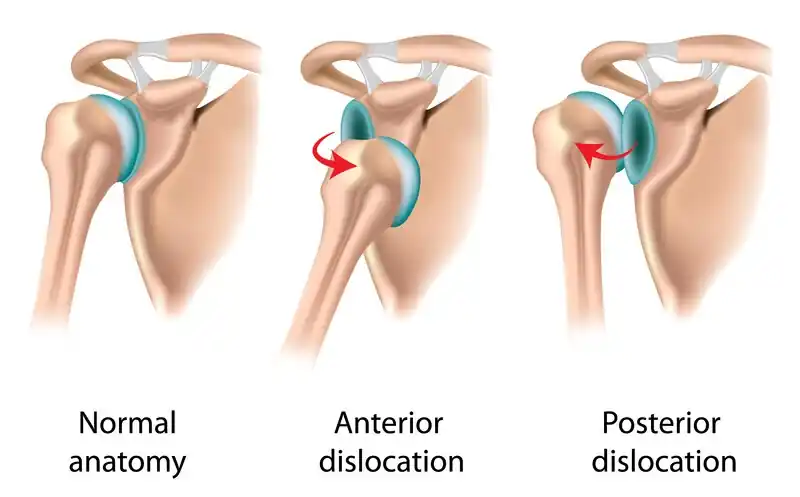
Dislocations are classified by the direction the ball moves out of the socket:
- Anterior Dislocation: This is by far the most common type, accounting for about 95% of all cases. The humeral head is pushed forward, coming to rest in front of the socket.
- Posterior Dislocation: In this less common type, the ball is pushed backward, behind the socket. This can happen from a direct blow to the front of the shoulder or from violent muscle contractions, such as during a seizure or electric shock.
- Inferior Dislocation: This is the rarest type, where the ball is forced downward.
Signs and Symptoms of a Dislocated Shoulder
A shoulder dislocation is typically a very obvious and painful injury. The signs and symptoms are often immediate and severe:
- Intense Pain: A sudden, sharp pain at the moment of injury is the most prominent symptom. Any attempt to move the shoulder is extremely painful.
- Visible Deformity: The shoulder may look "out of place" or squared-off. In an anterior dislocation, you might see a bulge in the front of the shoulder where the ball has moved, and a hollow area or divot below the bony point of the shoulder where the ball should be.
- Inability to Move the Arm: The arm on the affected side will be difficult or impossible to move. The person will likely be holding the arm close to their body to support it and prevent movement.
- Swelling and Bruising: The shoulder will quickly begin to swell, and bruising may develop over the next day or two.
- Muscle Spasms: The muscles around the shoulder often go into spasm as they try to protect the injured joint, which can intensify the pain.
- Numbness or Tingling: The dislocation can stretch or pinch the nerves that run down the arm, causing numbness, tingling, or a "pins and needles" sensation in the arm, hand, or fingers. This is a sign of nerve involvement and should be mentioned to a doctor immediately.
If you suspect you or someone else has a dislocated shoulder, it is crucial to seek immediate medical attention.
What to Do (and Not Do) for a Dislocated Shoulder
A dislocated shoulder is a medical emergency that needs to be handled by a trained professional.
What you should do:
- Immobilize the Arm: Do not try to move the shoulder. Keep the arm as still as possible. You can create a makeshift sling with a towel, belt, or piece of clothing to support the arm and hold it against the body.
- Apply Ice: If possible, apply an ice pack to the shoulder. This can help reduce pain and swelling while you wait for medical help.
- Seek Immediate Medical Care: Go to an emergency room or urgent care clinic. The longer the shoulder remains dislocated, the more difficult it can be to put back in and the greater the risk of further damage.
What you should NOT do:
- Do not try to pop the shoulder back in yourself. Attempting to reduce a dislocation without proper training can cause serious, permanent damage to the ligaments, tendons, bones, nerves, or blood vessels around the shoulder. This is not the time for heroics you may have seen in movies.
At the hospital, a doctor will confirm the dislocation with a physical exam and usually an X-ray. The X-ray ensures there are no broken bones before they attempt to put the joint back in place. The procedure to put the shoulder back is called a reduction. The doctor will use gentle maneuvers and traction to guide the humeral head back into the socket. This is often done after the patient has been given medication for pain and muscle relaxation.
Once the shoulder is successfully reduced, the intense pain usually subsides dramatically. You will likely be placed in a sling to immobilize the shoulder and allow the injured tissues to begin healing.
The Aftermath: Damage Caused by a Dislocation
A dislocation is more than just a joint temporarily out of place; it's a significant injury that can cause lasting damage to the shoulder's stabilizing structures. When the ball is forced out of the socket, it can stretch or tear the very tissues meant to hold it in.
Common injuries that occur during a dislocation include:
- Labral Tears (Bankart Lesion): The most common damage from an anterior dislocation is a tear of the labrum at the front of the socket. This specific injury is called a Bankart lesion. When the labrum is torn, the "bumper" that helps contain the ball is damaged, making the shoulder less stable.
- Stretched Ligaments and Capsule: The violent event stretches or tears the joint capsule and the ligaments that reinforce it. Even after healing, these tissues may remain permanently stretched out, similar to an overstretched rubber band, leaving the joint loose.
- Bone Damage (Hill-Sachs Lesion): As the humeral head dislocates, it can impact against the rim of the socket, creating a dent or compression fracture on the back of the ball. This is known as a Hill-Sachs lesion. The socket rim can also be chipped, creating a "bony Bankart" lesion. These bony injuries can make the shoulder even more prone to future dislocations.
- Rotator Cuff Tears: Especially in older individuals, the force of a dislocation can also tear the rotator cuff tendons.
This structural damage is the reason why a single dislocation can be the start of a bigger problem: chronic shoulder instability.
From Dislocation to Chronic Instability
Once you've dislocated your shoulder, you are at a much higher risk of it happening again. The initial injury compromises the shoulder's natural stability, leaving it vulnerable. This condition is known as traumatic shoulder instability.
The person may feel a persistent sense of looseness in the shoulder or an unsettling feeling that the shoulder is about to "give way" or slip out again. This feeling, known as apprehension, is common when the arm is moved into a position similar to the one that caused the original injury (for example, raising the arm up and back as if to throw a ball).
Future dislocations or partial dislocations (subluxations) can occur with much less force. What once took a high-impact tackle might now happen while reaching for something, rolling over in bed, or even just stretching. Each subsequent dislocation can cause further damage, creating a vicious cycle of worsening instability.
The risk of re-dislocation is especially high in young, active individuals. For people in their teens and early twenties, the recurrence rate after a first-time traumatic dislocation can be very high. This is because their ligaments may not heal as tightly, and they are more likely to return to high-risk sports and activities.
Conclusion
A shoulder dislocation is a serious injury that requires immediate medical attention. It is characterized by severe pain, a visible deformity of the shoulder, and an inability to move the arm. While a doctor can put the joint back in place, the initial trauma can cause lasting damage to the ligaments, labrum, and bone.
This damage often leads to chronic shoulder instability, a condition where the shoulder feels loose and is prone to dislocating again with less and less force. Living with an unstable shoulder can be limiting and stressful, as the fear of another dislocation can affect daily activities and participation in sports.
If you have experienced a shoulder dislocation, it is essential to follow up with an orthopedic specialist. They can fully assess the damage to your joint and guide you on the best path forward to regain stability and confidence in your shoulder. With proper care and rehabilitation, many people can successfully manage their shoulder instability and return to an active lifestyle.
Frequently Asked Questions
Can a dislocated shoulder pop back in on its own?
Sometimes, a shoulder may reduce (pop back in) spontaneously, but this is not common. In most cases, it requires a medical professional to perform a reduction. You should not assume it will go back on its own and should seek medical help immediately.
What is the difference between a shoulder dislocation and a shoulder separation?
These are two different injuries affecting different joints. A shoulder dislocation involves the main ball-and-socket joint, where the upper arm bone comes out of the shoulder blade's socket. A shoulder separation involves the acromioclavicular (AC) joint, where the collarbone separates from the shoulder blade. A separation causes a bump on top of the shoulder.
How long does it take to recover from a shoulder dislocation?
The initial recovery after a reduction involves a period of immobilization in a sling, typically for a few weeks, to allow the soft tissues to start healing. This is usually followed by physical therapy to restore range of motion and strength. Full recovery can take several months, but the timeline depends on the extent of the damage and the individual's activity level.
Will I need surgery after a shoulder dislocation?
Not everyone who dislocates their shoulder needs surgery. The decision depends on many factors, including your age, activity level, the extent of the structural damage (like a labral tear), and whether the shoulder has dislocated multiple times. Many first-time dislocations are managed without surgery, focusing instead on rehabilitation. However, for young athletes or those with recurrent dislocations, surgery to repair the damaged structures may be considered to restore stability.
If I've dislocated my shoulder once, will it happen again?
The risk of re-dislocation is significantly higher after the first event. The younger and more active you are, the higher the likelihood of it happening again. Proper rehabilitation to strengthen the supporting muscles can help reduce this risk, but the underlying structural damage from the first injury remains a key factor.
What is a subluxation?
A subluxation is a partial dislocation. In this event, the ball of the humerus slips partially out of the socket and then pops back in on its own. It can feel like a sudden slip, clunk, or a "giving way" sensation and is often painful. It is a common symptom of shoulder instability.
Is it safe to play sports after a shoulder dislocation?
Returning to sports is possible but should be done with caution and after clearance from your doctor or physical therapist. You will need to complete a full rehabilitation program to regain strength, stability, and confidence in your shoulder. For contact sports or high-risk activities, the risk of re-injury will be an important topic to discuss with your healthcare provider.