Understanding Shoulder Impingement: A Guide for Patients
Shoulder impingement is one of the most common reasons people experience shoulder pain. It happens when the tendons or the bursa (a small lubricating sac) in your shoulder get pinched by the surrounding bones during movement. This pinching, or "impingement," can cause pain, inflammation, and limit your ability to use your arm comfortably.
This condition is often referred to as shoulder impingement syndrome, subacromial impingement, or simply impingement. It is closely related to other shoulder issues like rotator cuff tendinitis (inflammation of the tendons) and shoulder bursitis (inflammation of the bursa), as these problems are often caused by the same mechanical pinching.
Shoulder impingement can affect anyone, from young athletes to older adults. It is particularly common in people who perform repetitive overhead motions, such as swimmers, baseball players, painters, and construction workers. However, it can also develop gradually without any obvious cause. This guide will provide a clear, high-level overview of shoulder impingement to help you understand what it is, what causes it, the symptoms to look for, and how it is diagnosed.
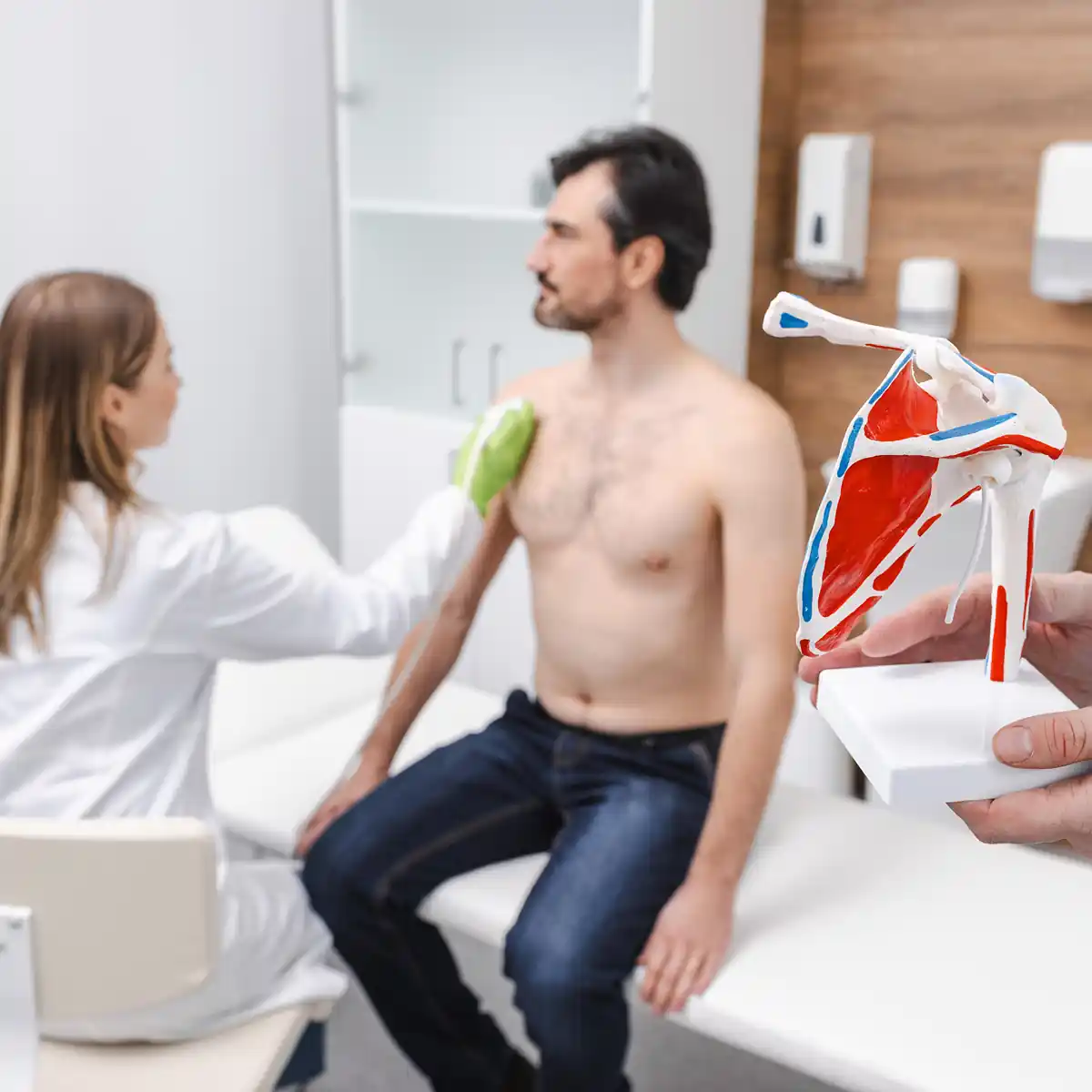
What is Happening Inside an Impinged Shoulder?
To grasp what shoulder impingement is, it helps to have a basic picture of the shoulder's anatomy. Your shoulder is a ball-and-socket joint made up of three main bones: the upper arm bone (humerus), the shoulder blade (scapula), and the collarbone (clavicle).
The top part of your shoulder blade forms a bony roof over the joint called the acromion. Underneath this bony roof lies a group of four important tendons known as the rotator cuff. These tendons connect your shoulder blade to your upper arm bone and are responsible for stabilizing the joint and allowing you to lift and rotate your arm. Between the acromion and the rotator cuff tendons sits a small, fluid-filled sac called the subacromial bursa. This bursa acts as a cushion, allowing the tendons to glide smoothly when you move your arm.
In a healthy shoulder, there is enough space for all these parts to move freely. However, the space under the acromion is naturally quite narrow. Shoulder impingement occurs when this space, called the subacromial space, becomes too small. When you lift your arm, the acromion bone rubs against or pinches the rotator cuff tendons and the bursa, leading to irritation, inflammation, and pain.
Imagine a rope passing through a narrow pulley. If the rope becomes frayed and thickened, or if the pulley develops a sharp edge, the rope will start to rub and wear down. A similar process happens in your shoulder. The "pinching" can occur for a few reasons:
- Swollen Tissues: The rotator cuff tendons or the bursa can become swollen and inflamed from overuse or injury. These swollen tissues take up more space, making them more likely to get squeezed.
- Bone Spurs: Over time, small bony growths called bone spurs can develop on the underside of the acromion. These spurs reduce the available space and can act like a sharp edge rubbing against the tendons.
- Anatomical Shape: Some people are born with an acromion that is more curved or hooked, naturally leaving less room for the tendons and bursa. This anatomical variation can make a person more prone to impingement.
This mechanical rubbing creates a vicious cycle. The pinching causes inflammation, which makes the tissues swell, which in turn leads to more pinching. This entire scenario of pain and inflammation caused by pinching under the acromion is what doctors call shoulder impingement syndrome.
Causes and Common Risk Factors
Shoulder impingement is most often considered an overuse injury that develops from repetitive stress rather than a single traumatic event. However, a variety of factors can cause or contribute to the condition.
Repetitive Overhead Activities
This is the most common cause. Any activity that involves frequently lifting your arm above shoulder level can lead to impingement. The repetitive motion can cause cumulative wear and tear, leading to inflammation of the tendons and bursa.
- Sports: Athletes in sports like swimming, baseball (especially pitchers), tennis (serving), and volleyball (spiking) are at high risk.
- Occupations: Jobs that require frequent overhead work, such as painting, carpentry, construction, or stocking high shelves, place continuous stress on the shoulder.
Age-Related Wear and Tear
As we get older, our tendons can naturally degenerate and become less flexible, a condition known as tendinosis. These thickened tendons take up more space and are more easily pinched. The formation of bone spurs on the acromion also becomes more common with age, further narrowing the subacromial space. This is why impingement is very common in middle-aged and older adults, even those who are not particularly active.
Poor Posture and Muscle Imbalances
The way you hold your body can have a significant impact on your shoulder health.
- Slouching Posture: Constantly rounding your shoulders forward, a common posture for desk workers, can cause the shoulder blades to tilt in a way that narrows the space for the rotator cuff.
- Muscle Weakness: Weakness in the rotator cuff muscles or the muscles that stabilize the shoulder blade can disrupt the shoulder's normal mechanics. A weak rotator cuff may not be able to keep the "ball" of the arm bone properly centered in the socket, allowing it to ride up and pinch the structures above it.
- Muscle Imbalance: If some shoulder muscles are much stronger than others (for example, strong chest muscles and weak upper back muscles), it can pull the shoulder out of its optimal alignment, increasing the risk of impingement.
Shoulder Anatomy
As mentioned, some people are simply born with a hooked or curved acromion that provides less clearance for the tendons. This structural predisposition makes them more likely to develop impingement, sometimes with only minimal overuse.
Acute Injury
While less common, a sudden injury like a fall directly onto the shoulder or bracing yourself during an accident can cause immediate swelling and inflammation, triggering acute impingement symptoms.
Often, impingement is the result of a combination of these factors. For example, a person with a naturally hooked acromion who starts a new job as a painter has a compounded risk. Understanding the contributing factors is a key part of managing the condition and preventing it from recurring.
Recognizing the Symptoms of Shoulder Impingement
The symptoms of shoulder impingement often start mildly and gradually become more persistent and severe. The classic signs include:
- Pain with Overhead Movement: This is the most defining symptom. You may feel a sharp, pinching pain when you reach overhead, out to the side, or behind your back. Activities like putting on a jacket, reaching for something on a high shelf, or throwing a ball can become painful.
- Pain in the Front or Side of the Shoulder: The discomfort is typically located at the front or outer side of the shoulder and may radiate partway down the upper arm. The pain usually does not travel past the elbow.
- Pain at Night: Night pain is a very common and frustrating symptom. The dull, aching pain can make it difficult to fall asleep or wake you up during the night, especially if you roll onto the affected shoulder.
- Weakness in the Arm: The affected arm may feel weak, particularly when you try to lift objects or perform overhead tasks. This weakness is often due to pain inhibiting the muscles, but over time, actual muscle strength can decrease from disuse.
- Stiffness and Limited Motion: You might find it difficult to move your shoulder as freely as you used to. Reaching behind your back to tuck in a shirt or fasten a bra can become particularly difficult and painful.
- A "Painful Arc": Many people experience a specific arc of movement where the pain is most intense. Lifting the arm out to the side might be comfortable at first, become painful in the mid-range (roughly between shoulder and head level), and then feel slightly better if you can get it all the way overhead. This happens because the pinching is most pronounced in that middle range.
- Clicking or Popping: You might feel or hear a clicking or popping sensation in the shoulder when you move it. This is often caused by the inflamed tendons or bursa rubbing against the bone.
It is important to note that symptoms like numbness, tingling, or burning that radiate down into the hand are not typical of shoulder impingement and may suggest a nerve issue, such as a pinched nerve in the neck.
If you experience these symptoms, especially if they persist for more than a couple of weeks or interfere with your daily life, it is a good idea to see a healthcare provider. Ignoring the symptoms can allow the condition to worsen over time.
How is Shoulder Impingement Diagnosed?
A healthcare provider can usually diagnose shoulder impingement based on your symptoms and a physical examination.
Your doctor will start by asking about your medical history, your activities, and when the pain began. This information provides important clues about the potential cause.
Next, a physical exam will be performed. The provider will:
- Press on different areas of your shoulder to check for tenderness.
- Assess your range of motion by asking you to move your arm in various directions.
- Perform specific "impingement tests," such as the Hawkins test, where your arm is moved into a position that narrows the subacromial space to see if it reproduces your pain.
- Test the strength of your rotator cuff and other shoulder muscles.
- Examine your neck to rule out any nerve issues that could be referring pain to your shoulder.
While the diagnosis is often clear from the history and exam, your doctor may order imaging tests to confirm it or to rule out other problems.
- X-rays: An X-ray does not show soft tissues like tendons, but it is very useful for examining the bones. It can reveal bone spurs on the acromion or an abnormally shaped acromion that could be causing the impingement.
- MRI or Ultrasound: These imaging studies provide detailed pictures of the soft tissues. They can show inflammation in the tendons and bursa (tendinitis and bursitis) and can also detect if there is a tear in the rotator cuff. Chronic impingement can sometimes lead to rotator cuff tears, so it's important to know the full extent of any damage.
The Importance of Seeking Care
It can be tempting to try to "work through" shoulder pain, but with impingement, this can make the problem worse. Continued pinching and inflammation can lead to progressive damage to the rotator cuff tendons. What starts as simple irritation can become a more serious partial or full-thickness tear over time. A rotator cuff tear is a more significant injury that can lead to a much longer and more complicated recovery.
Furthermore, if you avoid moving your arm for a long time because of pain, you risk developing significant stiffness or even a secondary "frozen shoulder." Getting a proper diagnosis and guidance early on is the best way to prevent these complications.
The good news is that the outlook for shoulder impingement is generally very good. Most cases respond well to conservative, non-surgical care. With appropriate management, most people can achieve significant pain relief and return to their normal activities.
Frequently Asked Questions
Can shoulder impingement heal on its own?
Mild cases may improve with rest and by avoiding aggravating activities. However, if the underlying cause (like poor posture or repetitive motion) is not addressed, the pain is likely to return. For persistent or moderate to severe pain, medical guidance is recommended.
How long does it take to recover from shoulder impingement?
Recovery time varies widely. Minor cases might resolve in a few weeks with proper care. More chronic or severe cases can take several months of dedicated rehabilitation to fully heal.
What's the difference between impingement and a rotator cuff tear?
Impingement is the pinching of the tendons, while a rotator cuff tear is an actual rip in the tendon fibers. They are related, as chronic impingement can lead to a tear. Symptoms can be similar, but tears often cause more significant and persistent weakness. An MRI or ultrasound can tell the difference.
Should I completely stop moving my shoulder if it hurts?
You should avoid movements that cause sharp pain, but complete rest is not ideal as it can lead to stiffness. Gentle, pain-free range-of-motion exercises are often encouraged to maintain mobility. A healthcare provider or physical therapist can guide you on the right balance of rest and movement.
Is it okay to exercise with shoulder impingement?
You should avoid painful exercises, especially those involving overhead lifting. However, specific strengthening and stretching exercises, particularly for the rotator cuff and upper back muscles, are a cornerstone of recovery. It is best to perform these under the guidance of a professional.
Why does my shoulder hurt more at night?
When you lie down, the pressure from your body weight can compress the inflamed tissues in your shoulder. Also, the position of your shoulder when lying on your side can further narrow the subacromial space. This increased pressure on already irritated tissues leads to more pain.
Can bad posture at my desk really cause shoulder pain?
Yes. Slouching with rounded shoulders causes your shoulder blades to tip forward and down, which reduces the space under the acromion. Over time, this postural habit can directly contribute to the mechanical pinching of shoulder impingement.