Understanding SLAP Tears: A Patient's Guide to this Shoulder Injury
A SLAP tear is a specific type of injury to the labrum, which is the ring of cartilage that helps stabilize your shoulder joint. The term SLAP is an acronym that stands for Superior Labrum Anterior to Posterior. This means the tear occurs at the top part of the labrum, running from the front to the back. This is a critical area because it's also where one of the main biceps tendons attaches to the shoulder socket.
SLAP tears can cause deep-seated shoulder pain, weakness, and a feeling of instability, making it difficult to perform daily activities, especially those involving overhead movements. While they represent a smaller fraction of all shoulder injuries, they can be a significant source of discomfort and dysfunction. Understanding what a SLAP tear is, how it happens, and what symptoms to look for is the first step toward getting a proper diagnosis and on the path to recovery.
This guide will offer a high-level overview of SLAP tears, designed to be clear and easy for patients to understand. We will explore the anatomy of the shoulder, the different types of SLAP tears, their common causes, the symptoms they produce, and how healthcare providers diagnose the condition.
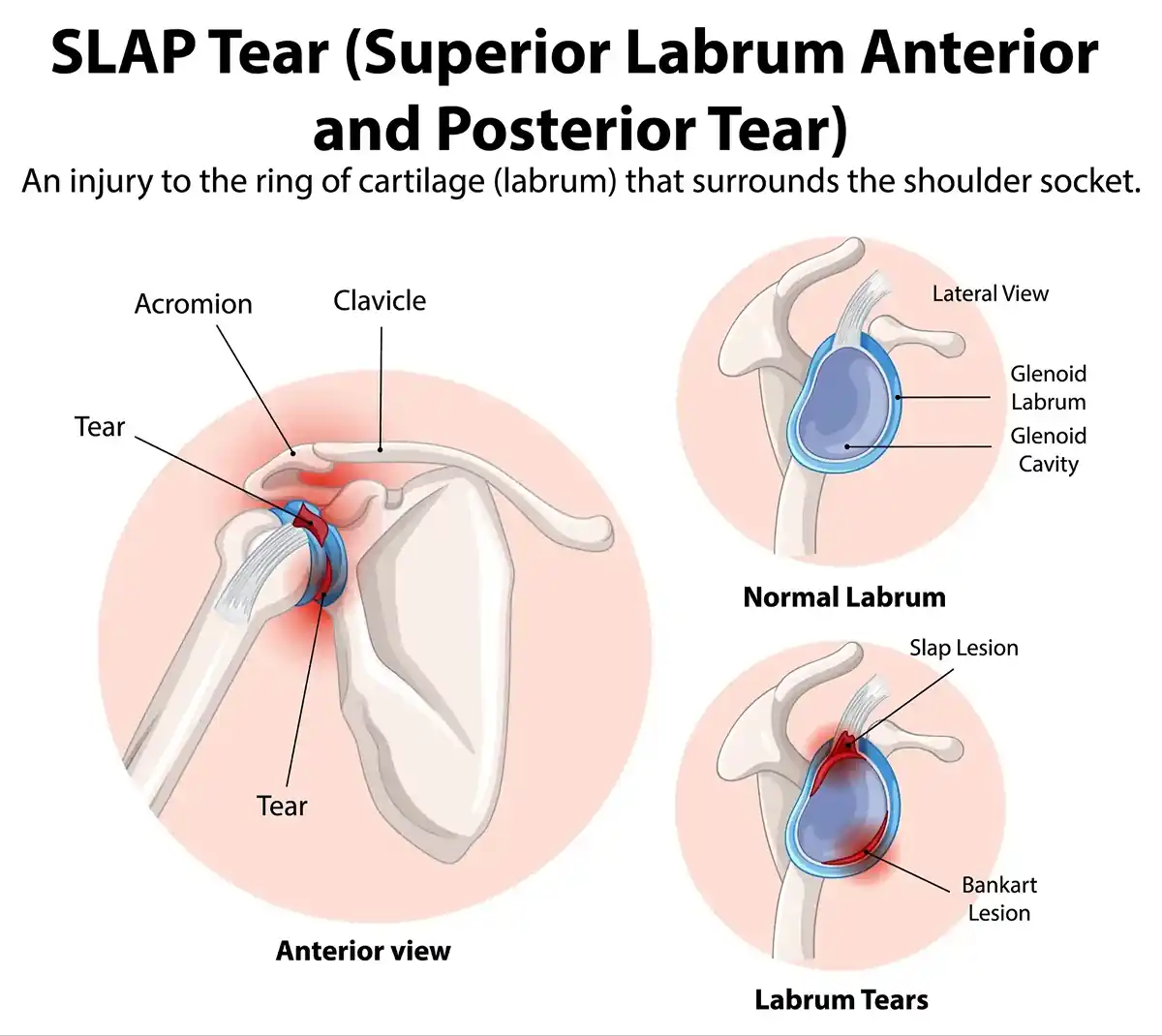
A Look Inside the Shoulder: The Role of the Labrum
To understand a SLAP tear, it’s helpful to know a little about the shoulder's structure. The shoulder is a ball-and-socket joint. The "ball" is the top of your upper arm bone (humerus), and the "socket" is a shallow depression in your shoulder blade (scapula) called the glenoid.
Because the socket is so shallow, the shoulder joint is naturally less stable than other joints, like the hip. To make up for this, the shoulder relies on a team of supporting structures. One of the most important is the labrum.
The labrum is a ring of tough, flexible cartilage attached to the rim of the shoulder socket. You can think of it as a rubber gasket or a bumper. Its main jobs are:
- Deepening the Socket: The labrum effectively makes the shallow socket deeper, creating a more secure fit for the ball of the humerus.
- Providing Stability: By improving the fit, it helps keep the shoulder joint stable and prevents it from dislocating easily.
- Serving as an Anchor: The labrum also acts as an attachment point for several important ligaments and, crucially for SLAP tears, the long head of the biceps tendon.
The biceps tendon attaches directly to the top of the labrum. This connection means that forces from the biceps muscle can be transmitted to the labrum. It also means that an injury to this area can affect both the labrum and the biceps tendon. A tear in this vital structure can disrupt the shoulder's stability and cause significant pain and mechanical issues.
What is a SLAP Tear?
A SLAP tear is an injury to the very top part of the labrum. The tear occurs where the biceps tendon anchors to the labrum, and it extends from the front (anterior) of the labrum to the back (posterior). In simple terms, the top section of the cartilage "gasket" has been torn or pulled away from the bone of the shoulder socket.
Because the biceps tendon attaches right at the site of a SLAP tear, the injury can compromise this anchor point. This can lead to irritation or damage to the biceps tendon itself, which is why some people with a SLAP tear feel pain specifically in the front of their shoulder or when using their biceps muscle. The tear creates a frayed or loose flap of cartilage in the joint, which can cause pain, clicking, and a feeling that the shoulder is not moving smoothly.
Types of SLAP Tears
Doctors classify SLAP tears into different types based on the severity and pattern of the tear. While you don’t need to memorize these, knowing them can help you understand what a surgeon might see on an MRI or during a procedure.
- Type I: This is the mildest form, involving fraying and degeneration of the top of the labrum. The labrum is worn down, like the edge of a frayed rope, but it is still firmly attached to the socket. This type is often seen in middle-aged and older adults as a result of normal wear and tear.
- Type II: This is the most common type of SLAP tear. In a Type II tear, the top part of the labrum and the biceps anchor have completely detached from the bone of the socket. This creates an unstable situation, as the anchor for the biceps is no longer secure.
- Type III: This is known as a "bucket-handle" tear. A piece of the labrum is torn and hangs down into the joint, but the biceps anchor itself remains intact. The torn flap of cartilage can get caught during shoulder movement, causing a painful catching or locking sensation.
- Type IV: This is a more complex injury where the bucket-handle tear of the labrum extends up into the biceps tendon itself. This means both the labrum and the biceps tendon are torn.
What Causes a SLAP Tear?
SLAP tears can happen from a single, traumatic event (an acute injury) or develop slowly over time from repetitive stress (a chronic injury). Age-related degeneration can also be a factor.
Acute Trauma
A sudden, forceful event is a common cause of SLAP tears. Examples include:
- A fall onto an outstretched arm.
- A direct blow to the shoulder, such as in a contact sport.
- A sudden, sharp pull on the arm, like when trying to catch a heavy object.
- A forceful, rapid movement of the arm, such as when trying to stop a fall or slide.
- A shoulder dislocation, where the ball of the joint is forced out of the socket.
Repetitive Overuse
Gradual wear and tear from repetitive overhead motions is another major cause, especially in athletes. Activities that place repeated stress on the biceps-labrum connection can lead to fraying and eventual tearing.
- Throwing Sports: Baseball pitchers, quarterbacks, and other throwing athletes are at high risk. The motion of throwing puts immense strain on the labrum.
- Overhead Sports: Tennis players (serving), volleyball players (spiking), and swimmers also place significant repetitive stress on their shoulders.
- Weightlifting: Repetitive or heavy overhead lifting can strain the labrum and lead to a tear over time.
Age-Related Degeneration
As we age, the cartilage in our bodies naturally becomes more brittle and prone to injury. For people over 40, the labrum can begin to fray and weaken. A degenerated labrum can tear with less force than a healthy one, meaning a minor stumble or awkward movement might be enough to cause a SLAP tear in an older adult. These degenerative tears are often less severe (like a Type I tear) but can still cause pain and dysfunction.
Often, a combination of factors is at play. An older athlete, for instance, may have both age-related wear and a history of overuse, making them particularly vulnerable to a SLAP tear.
Common Symptoms of a SLAP Tear
SLAP tears can be difficult to identify based on symptoms alone, as they often overlap with other shoulder problems like rotator cuff injuries or impingement. However, there are some classic signs to look for.
- A Deep, Aching Pain: The pain is usually felt deep inside the shoulder joint rather than on the surface. It can be a constant dull ache that turns into a sharp pain with certain movements.
- Pain with Specific Movements: You will likely notice pain when lifting your arm overhead, reaching behind your back, or performing a throwing motion.
- Mechanical Symptoms (Clicking, Popping, Catching): This is a key indicator of a labral tear. You may feel or hear a clicking, popping, grinding, or catching sensation when you move your shoulder. This is caused by the torn piece of labrum getting caught in the joint.
- A Feeling of Instability: The shoulder may feel "loose" or unstable, as if it is going to slip out of place. This can make you hesitant to move your arm quickly or forcefully.
- Shoulder Weakness: Many people report a loss of strength in the affected shoulder. Lifting objects may become difficult, and the shoulder might feel like it "gives out."
- Loss of Range of Motion: Pain and mechanical issues can make it hard to move your shoulder through its full range. You may struggle to rotate your arm or lift it as high as you used to.
- "Dead Arm" Sensation in Athletes: Throwing athletes with a SLAP tear often report a "dead arm" feeling, where the arm feels weak and fatigued after throwing. They may also notice a significant drop in their throwing speed and accuracy.
The intensity of these symptoms can vary depending on the size and type of the tear. A small, degenerative tear might only cause mild, intermittent discomfort, while a large, traumatic tear can be intensely painful and debilitating.
How Doctors Diagnose a SLAP Tear
Diagnosing a SLAP tear requires a careful and systematic approach from a healthcare provider, typically an orthopedic specialist.
- Medical History: The first step is a detailed discussion about your symptoms. Your doctor will ask about any specific injuries, your participation in sports or overhead work, what movements cause pain, and whether you experience any clicking or instability.
- Physical Examination: Your doctor will perform a thorough examination of your shoulder. This will involve checking your range of motion, testing your muscle strength, and assessing the stability of the joint. They will also perform several "provocative tests," which are specific maneuvers designed to stress the labrum. Pain or a click during these tests can strongly suggest a SLAP tear.
- Imaging Tests:
- X-rays: While an X-ray cannot show a tear in the soft-tissue labrum, it is an important first step to rule out other problems like fractures or arthritis.
- MRI (Magnetic Resonance Imaging): An MRI is the primary imaging tool used to visualize the labrum. To get the clearest picture, your doctor will likely order an MRI arthrogram. For this test, a contrast dye is injected into the shoulder joint before the scan. The dye fills the joint and will leak into any tear in the labrum, making it much easier to see on the MRI images.
Even with an MRI arthrogram, some small SLAP tears can be difficult to see. The definitive diagnosis is sometimes only made with shoulder arthroscopy, a minimally invasive surgical procedure where a tiny camera is inserted into the shoulder joint, allowing the surgeon to directly visualize the labrum and confirm the presence and type of tear.
Preventing SLAP Tears
While not all SLAP tears can be prevented, you can take steps to reduce your risk, especially if you are an athlete or work in a job with repetitive overhead tasks.
- Proper Warm-up and Stretching: Always warm up your shoulder muscles before activity.
- Strengthening: Focus on a balanced strengthening program that includes the rotator cuff, the muscles around your shoulder blade, and your core. A strong and stable kinetic chain reduces the stress on the shoulder joint itself.
- Correct Technique: Use proper form during sports and lifting to avoid putting unnecessary strain on your shoulder.
- Avoid Overuse: Listen to your body. Incorporate rest days into your training schedule and don't push through pain. If your shoulder feels fatigued or sore, give it a break.
If you experience persistent shoulder pain, especially with clicking or a feeling of instability, it is important to see a doctor for an evaluation. Early diagnosis and management can prevent a minor issue from becoming a more significant problem.
Frequently Asked Questions
Can a SLAP tear heal on its own?
Because the labrum has a poor blood supply, it has a very limited ability to heal on its own. While symptoms from a very minor tear may improve with rest and therapy, a significant tear that has detached from the bone will not reattach by itself.
What is the difference between a SLAP tear and a rotator cuff tear?
A SLAP tear is an injury to the cartilage rim (labrum) of the shoulder socket. A rotator cuff tear is an injury to one or more of the tendons that surround the shoulder joint. While symptoms can be similar, a SLAP tear is more likely to cause mechanical symptoms like clicking and catching.
I have a SLAP tear. Does this mean I will need surgery?
Not necessarily. The decision to proceed with surgery depends on many factors, including the type of tear, your age, your activity level, and how much your symptoms are affecting your life. Many people, especially those with smaller or degenerative tears, can find significant relief with non-surgical management focused on physical therapy and pain control.
Is a SLAP tear a common injury?
SLAP tears are less common than other shoulder injuries like rotator cuff problems or impingement. They account for a relatively small percentage of all shoulder injuries but are more common in overhead athletes and following specific types of trauma.
If I have a SLAP tear, should I stop all activity?
You should avoid activities that cause pain, especially overhead motions. However, your doctor or physical therapist will likely recommend a program of specific exercises to maintain range of motion and strengthen the supporting muscles, which can help stabilize the shoulder and reduce symptoms.
Can I prevent a SLAP tear?
While you can't prevent accidents, you can reduce your risk of overuse-related tears by maintaining good shoulder strength and flexibility, using proper technique in sports and lifting, and avoiding overtraining. Listening to your body and not pushing through pain is one of the most important preventive measures.