Coonrad-Morrey (Elbow Replacement)
Indications and outcomes of the Coonrad–Morrey total elbow arthroplasty: a systematic review. Manuele Morandi Guaitoli, Antonio Mazzotti, Elena Artioli, Alberto Arceri, Alberto Ruffilli & Cesare Faldini
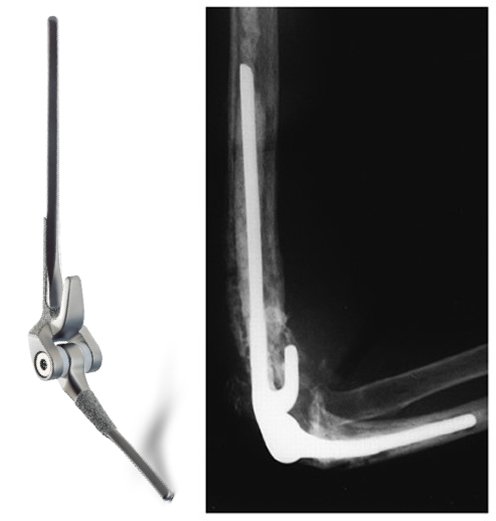
Background – Elbow Arthroplasty – Coonrad-Morrey
The Coonrad-Morrey prosthesis (CMP) is a widely applied semi-constrained implant that effectively counteracts compression and thrust on the hinge. The aim of this systematic review was to evaluate the indications and outcomes of CMP across different aetiologies for which it was implanted, particularly within the context of elbow replacement surgery.
Materials and methods
Selected articles were reviewed to extract: population data, surgical indications, preoperative and postoperative clinical outcomes, survival rate, and complications.
Results
A total of 873 TEAs were analysed. The majority of implants (74.8%) were in female, with a mean age of 62.8 years. Rheumatoid arthritis (RA) was the most common indication (69.9%), followed by post-traumatic sequelae (PTS) (12.1%) and acute fractures (FR) (12.1%). Improvement in functional scores were registered with a mean postoperative flexion–extension of 99.0° and a mean pronation-supination of 137.7°. A mean rate of 29.5% (range, 13.3%-71.4%) complications occurred, mechanical failure (9.04%) being the most frequent, highlighting the complexities in elbow replacement outcomes.
Conclusion
CMP shows favourable medium to long-term clinical outcomes for patients with RA and FR, especially when osteosynthesis is not feasible in elderly patients with low joint workload. Although CMP offered restored range of motion and functional improvements, the implant’s low overall survival rate and high complication rate require careful consideration, especially in assessing individual patient factors which are then necessary to determine the suitability of CMP as a therapeutic option for elbow replacement.
My Opinion – Elbow Replacement
When the patient needs are accurately assessed and accounted for with respect to the Benefits and Limits of Total Elbow Arthroplasty and the Coonrad-Morrey Prosthesis, the outcomes are acceptable. Outcomes of elbow replacement are pain relief, and mobility to allow activities of daily living. When patient selection is inappropriate, low volume surgeons with insufficient experience, or unforeseen circumstances intervene, poor outcomes and the need for revision surgery may result. Papers that don’t have sufficient detailed data to analyze may often mis-represent such a complex situation, especially regarding elbow replacement.
