Quadrangular Space Syndrome
Quadrangular Space Syndrome is a rare condition that the neural & vascular structures are entrapped in the quadrangular space for some reason.
Definition – Quadrangular Space
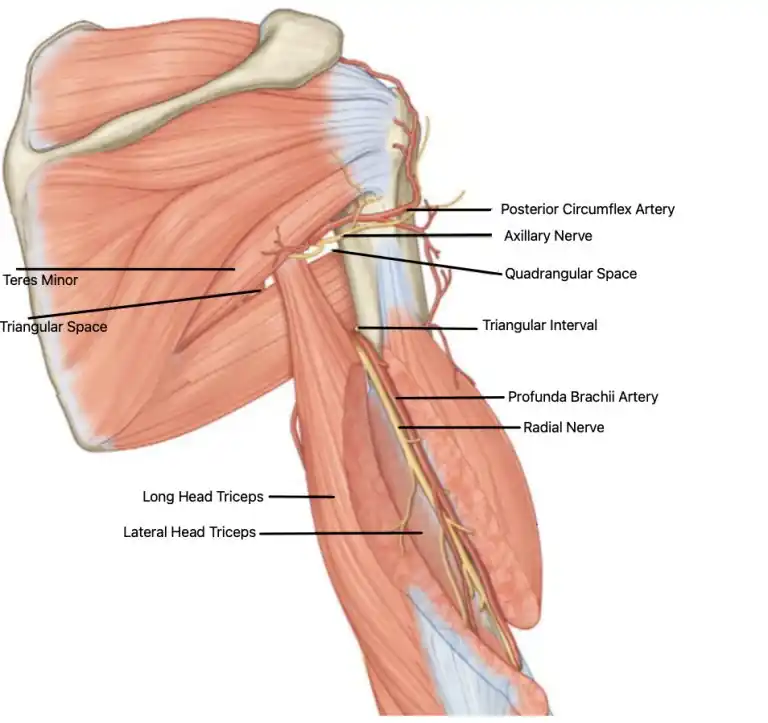
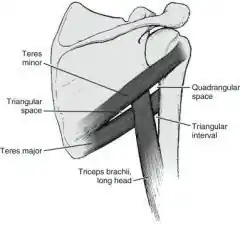
Quadrangular Space : “Quadrilateral Space” – It is an intermuscular space, defined by 4 sides (3 muscular and 1 bony border)
Location
It is located below the shoulder (glenohumeral) joint.
Anatomy (Borders)
- Superiorly: Subscapularis (anteriorly), Teres minor (posteriorly), shoulder joint capsule
- Inferiorly: Teres major
- Medially: Long head of triceps
- Laterally: Surgical neck of humerus
- Quadrangular space Posterior view ,right upper limb.
Anatomy (Contents)
There are two structures that pass through the quadrangular space (1 nerve, 1 artery):
1. Axillary nerve
Its fibers arise from the posterior cord of the brachial plexuses.
Divides after passing through the space into:
a) The anterior branch that innervates the deltoid m. & the skin over it.
b) The posterior branch that innervates the teres minor m. & continue as the superior lateral cutaneous nerve of the arm.
2. Posterior circumflex humeral vessels
It is a branch of the 3rd part of the axillary artery winds around the surgical neck of the humerus bone after passing through the space to share with arterial anastomosis around the shoulder joint.
Posterior view, right upper limb
Clinical Relevance
This space considers a passageway from the anterior region of the axilla to the posterior region of it.
This space is also vulnerable to “Quadrangular space syndrome”.
Causes
Any movement or structure that decreases the area of the quadrangular space so causes compression on the structures that pass through it.
- Fibrous bands which causes compression to the contents during shoulder abduction & external rotation .
- Scapular bone fracture.
- Benign or malignant mass.
Symptoms
- Pain in the shoulder.
- Non-cutaneously tingling on the lateral side of the shoulder & arm.
- These symptoms which are shown above, are increased during shoulder abduction & external rotation.
- Insensitivity over the quadrangular space on palpation.
- Neurotrophic loss of teres minor m. & deltoid m.
Diagnosis
- The specialist uses plain radiographs to detect fractures or any mass that cause pressure on the structures of the quadrangular space.
- The specialist uses the EMG to test the activity of the axillary nerve & exclusion of other nerve pain causes.
- The specialist uses MRI images or CT to detect muscle atrophy & detect the condition of the structures that passes through the space.
Diagnostic injection of lidocaine in a certain percentage at a selected point on the shoulder region, if the pain is decreased & the patient can perform the shoulder movements without pain, the test is considered positive.
Treatment
- The treatment is non-surgical treatment including non-steroidal anti-inflammatory drugs ( NSAIDs), alteration of the activity & physical therapy.
- If this method does t work to decrease the pain for 6 months, surgical treatment is needed
